
EN
 Português
Quality Inspection Standards for Musical Light Up and 3D Pop Up Cards
Quality Inspection Standards for Musical Light Up and 3D Pop Up Cards
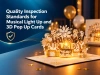
Functional greeting cards require more than a visual inspection. A musical card must play the correct audio, a light-up card must activate consistently, and a 3D pop-up card must open smoothly and hold its intended shape. Printing, paper engineering, electronics and hand assembly must all work together in the finished product.
A practical inspection plan therefore follows the product from incoming materials through production and final packing. The checkpoints should reflect the approved sample, written specification and intended use.

Use the approved sample as the reference
The final approved sample gives inspectors a physical reference for color, dimensions, structure, function and appearance. It should be supported by current artwork and a written specification. When the sample and document differ, the team must resolve the difference before production continues.
Key requirements should be measurable where possible. Examples include finished dimensions, audio version, playback behavior, light sequence, component position, packaging quantity and barcode content.
Inspect incoming materials
Paper, printed components, electronic modules, speakers, batteries, LEDs, wires, envelopes and packaging materials should be checked before assembly. The inspection confirms that the materials match the order and are free from obvious damage, contamination or incorrect labeling.
For functional components, sampling may include activation and basic performance tests. Finding an incorrect audio file or unstable switch before assembly avoids larger rework later.
Check printing and finishing
· Artwork version and language
· Color consistency against the approved reference
· Printing registration and image clarity
· Cutting, creasing and fold position
· Foil, embossing, glitter or other finishing
· Scratches, stains, dents and adhesive marks
Inspectors should consider normal production tolerance while separating acceptable variation from defects that affect appearance, function or brand presentation.
Test 3D pop up structures
A pop-up card should open to the intended angle without torn tabs, blocked movement or excessive force. The structure should stand in the correct position and return inside the card when closed. Glue must hold the assembly without spreading onto visible surfaces.
Repeated opening tests help identify weak joints, incorrect creases and parts that collide. The inspection should also confirm that the folded structure does not make the card too thick for the envelope or retail pack.
Test musical card functions
· Correct audio content and playback length
· Reliable activation when the card opens or the button is pressed
· Reset or stop behavior matches the specification
· Acceptable sound clarity and volume
· Speaker, battery and wiring remain secure
· No intermittent sound during normal handling
The card should be tested as a complete assembled product. Module performance can change when the speaker is enclosed or when a fold puts pressure on a wire or switch.
Test light up card functions
Inspectors should confirm that all required LEDs illuminate, colors and sequences are correct, and activation remains consistent. Light positions must align with the printed or die-cut design. Wires and components should remain concealed and secure so they do not distort the card surface.
When sound and light are combined, both functions should be tested together because they share the power source and activation system.
Inspect assembly workmanship
Many specialty cards include manual assembly. Inspection should check glue position, component alignment, clean edges, flatness and consistency between units. Components should not shift when the card is opened, closed or placed into its packaging.
A first-piece check at the start of assembly helps the production team identify an incorrect method before a larger quantity is completed. In-process inspection can then monitor whether the approved method is being followed.
Confirm packaging and labeling
· Correct card, envelope and insert are packed together
· Protective packaging matches the specification
· Barcode and labels are readable and correctly positioned
· Warnings or operating instructions are included when required
· Inner-box and carton quantities are correct
· Shipping marks match the order
Packaging should also be tested for fit. Pressure from an envelope or retail pack can accidentally activate an electronic card or damage a raised pop-up structure.
Complete final inspection before shipment
Final inspection reviews randomly selected finished goods after production and packing. The sampling method and acceptance criteria should be agreed according to the order, product risk and buyer requirements. Critical functional failures should be treated differently from minor cosmetic variation.
Inspection records should identify the order, product, quantity checked, defects found and disposition. When a problem is discovered, the manufacturer should separate affected goods, investigate the cause and confirm corrective action before shipment.
Quality control at Winpsheng
Winpsheng develops and manufactures specialty greeting cards for custom and private-label programs. Quality planning begins with a clear specification and approved sample, followed by checks that match the printing, structure, electronics, assembly and packaging of the product. Buyers can share their own inspection standard or work with the project team to define suitable checkpoints for a new design.
 Hot News



.webp?x-oss-process=image/resize,w_100/quality,q_100)
Contact US
Product Information
Quantity
Unit
Piece
Support order samples, customization, wholesale direct, and complete payment. If the product you look for does not have corresponding customized content, pls fill out the form below to contact us, and we will reply ASAP.